Market outlook
Stable Outlook 7/10
The card is a famous vintage Pikachu, but common printings are already well known and widely available. Price movement is more likely to be driven by grading demand and overall Pokémon nostalgia cycles than by true scarcity.
Next months. Likely to remain stable with modest grade-dependent fluctuations.
Long term. Expected to hold value well as a staple vintage Pikachu, with gradual appreciation most likely in high-grade copies.
History
Pikachu is the franchise mascot of Pokémon, introduced in the original 1996 Game Boy games Pokémon Red and Green in Japan. As an Electric-type Pokémon, Pikachu became the most recognizable character in the Pokémon brand and was central to the anime, merchandise, and trading card game identity.
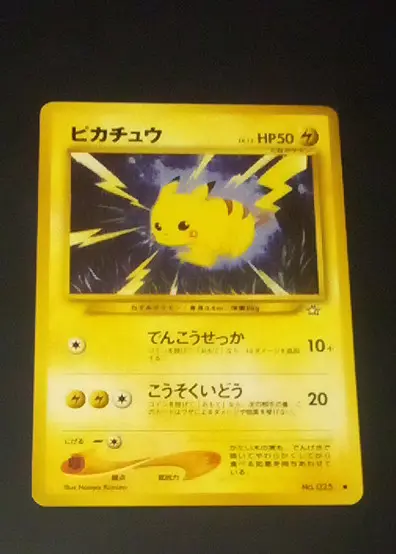
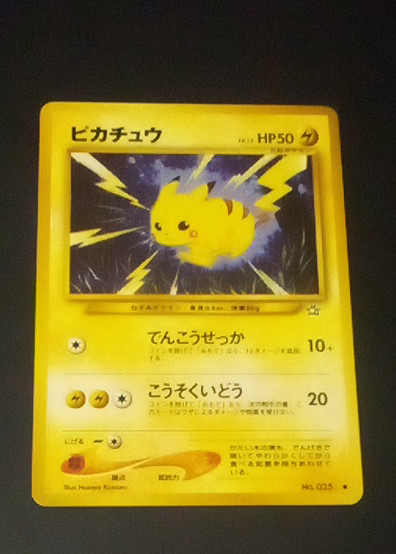
The Japanese Base Set Pikachu #025 was first released in Japan in the Pokémon Card Game Expansion Pack on October 20, 1996.
- This is the standard common Japanese Base Set Pikachu, not the much scarcer no-rarity first print version.
- Japanese Base Set Pikachu is part of the earliest Pokémon TCG print era and is one of the most collected vintage Pikachu cards.
- Market listings and price guides show the card is abundant in raw condition, with value driven mainly by grade and eye appeal rather than rarity.
Rarity and print run
- Tier
- Common
- Print run
- Very High
- First printed in
- Pokémon Card Game Expansion Pack
- Demand
- High
- Supply
- High
- It is a base common card from a heavily collected vintage set.
- Millions of collectors want Pikachu, but this specific printing was produced in large quantities.
- Scarcity improves only in top grades, especially graded 10 and pristine pack-fresh copies.
Collector notes
Condition. Check centering, edge whitening, corner wear, surface scratches, print lines, and holo-like scuffing on the yellow border and artwork area. Common flaws for this era include back whitening, corner dings, and light scratches from old storage or binder wear.
Storage. Store in a penny sleeve and semi-rigid or toploader, keep away from heat, moisture, and direct sunlight, and avoid tight binder pockets that can abrade the surface. For long-term preservation, use archival-safe materials and stable humidity.
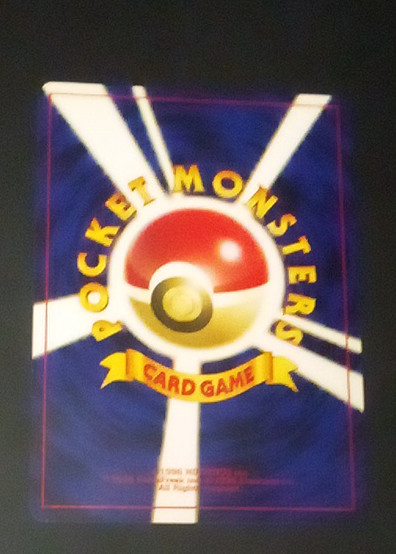
Authenticity. Authentic copies should have the correct Japanese old-back layout, proper card font, and clean print quality consistent with 1996 Japanese Pokémon cards. Watch for incorrect border color, blurry text, off-center logos, mismatched back texture, and suspiciously glossy modern reprints or altered no-rarity versions.
Sources: pricecharting.com, ebay.com, ebay.it, esporacarosario.com.ar, collectibles.com