Market outlook
Stable Outlook 7/10
Demand for Pikachu remains strong, but modern-era supply is generally sufficient to keep most releases from extreme scarcity unless grading populations stay low.
Next months. Likely to remain steady with modest movement based on grading demand and localized collector interest.
Long term. Likely to appreciate gradually if the exact Indonesian print remains harder to find and gem-mint copies stay relatively limited.
History
Pikachu is the franchise mascot of Pokémon, first introduced in the original Generation I games and the earliest Trading Card Game sets as an Electric-type Pokémon known for its cheerful design, broad appeal, and status as the face of the brand. As a card subject, Pikachu has been printed in more variants than almost any other Pokémon, making high-rarity Pikachu cards especially collectible.
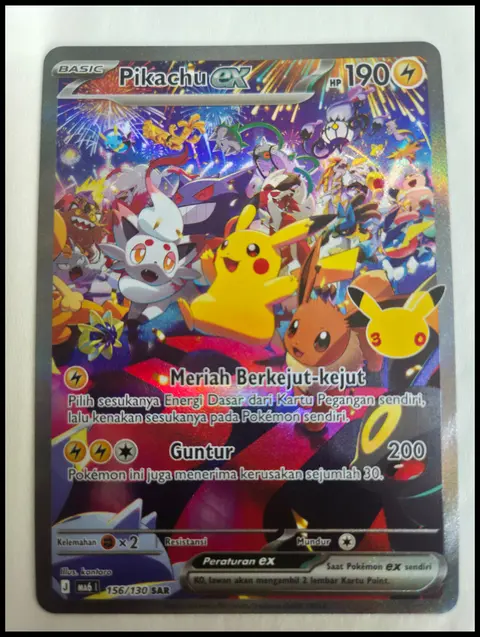
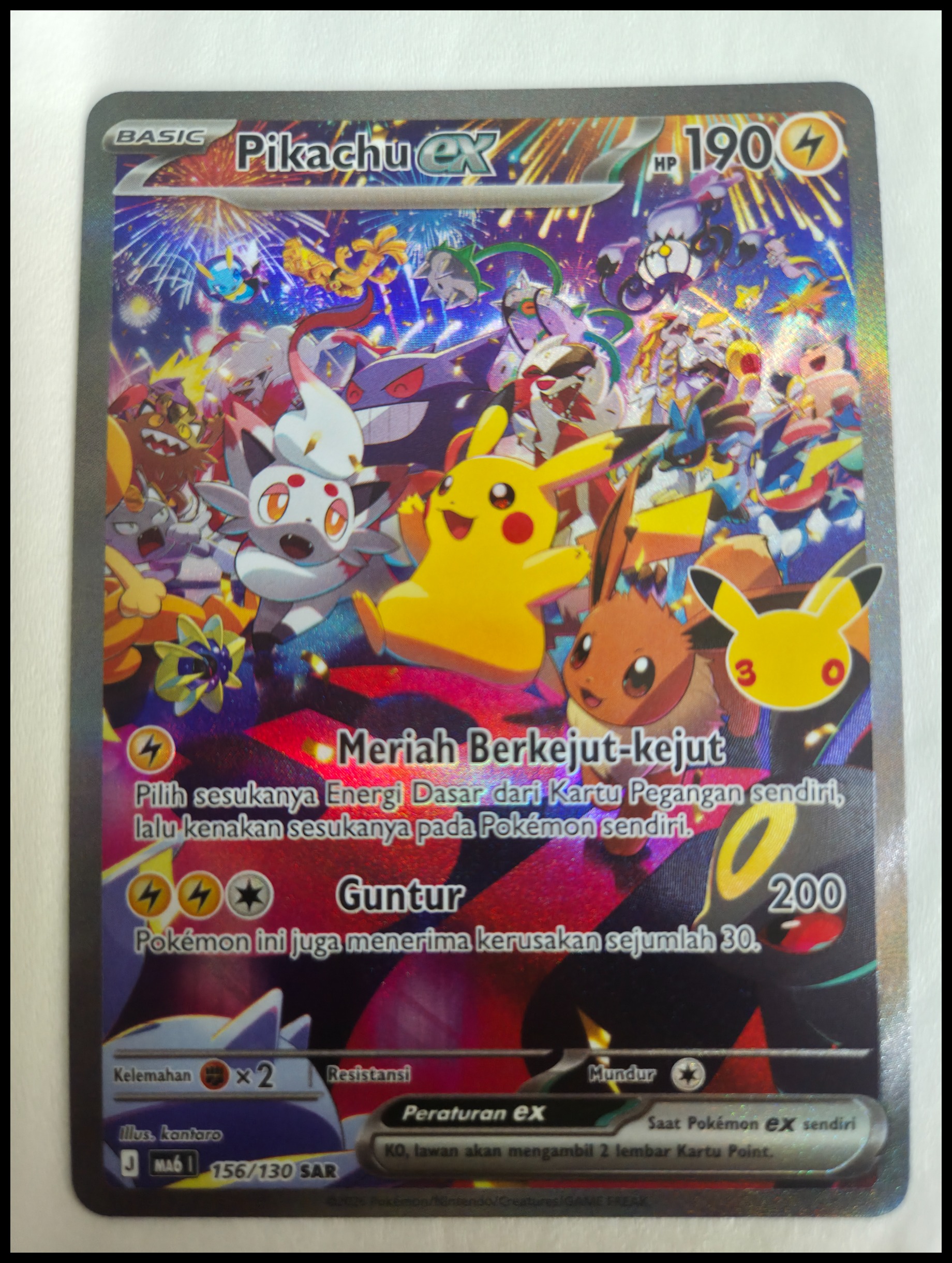
This specific Pikachu ex card is from the Japanese set Stellar Miracle, which released in 2024; the Indonesian-language version is a localized print derived from that release. The exact card number provided, 156/130, appears inconsistent with the standard set numbering for Stellar Miracle, so the identifier should be verified against the card image and local-language checklist.
- Pikachu ex is a high-demand chase character across multiple modern Pokémon TCG sets.
- Secret Rare and Full Art styling significantly increase collector interest compared with standard Pikachu prints.
- The Pokémon TCG has many Pikachu variants, so exact set, language, and numbering matter heavily for authentication and value.
Rarity and print run
- Tier
- Secret Rare
- Print run
- Very High
- First printed in
- Stellar Miracle
- Demand
- Very High
- Supply
- High
- Character-driven demand from Pikachu collectors
- Secret Rare full-art presentation
- Modern product may be opened in large volume, limiting extreme scarcity
- Exact language versions can be harder to source than English or Japanese in some markets
Collector notes
Condition. Check centering, corner whitening, edge wear, surface scratches, print lines, and holofoil scuffs. Full-art and secret-rares commonly show whitening on corners, surface scratching under light, and imperfect centering that can reduce grade.
Storage. Use a penny sleeve, then a rigid top loader or semi-rigid holder; keep the card in a dry, cool environment away from sunlight and humidity. For long-term preservation, store with acid-free materials and avoid repeated handling without clean hands or gloves.
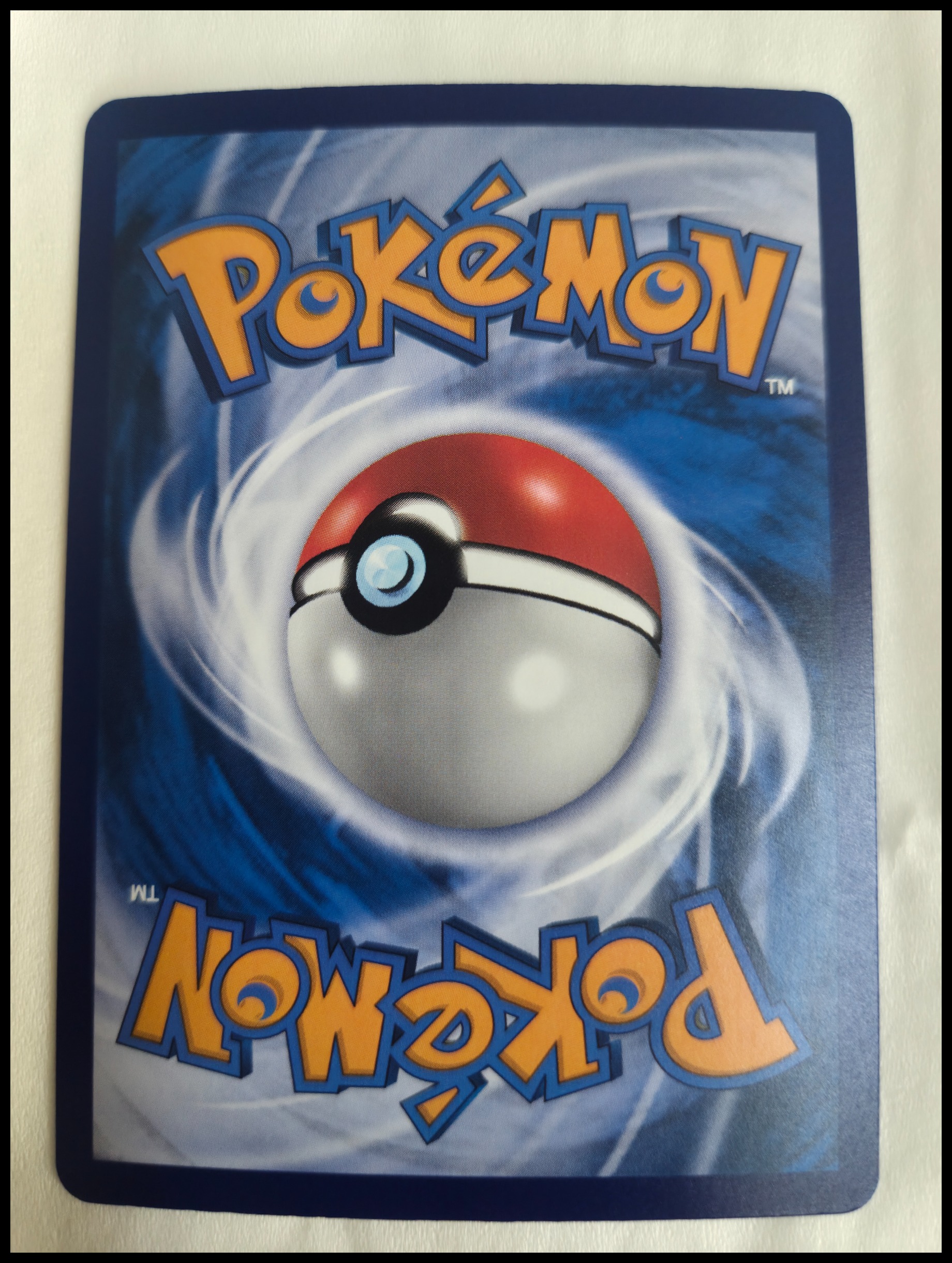
Authenticity. Verify correct font, set symbols, texture pattern, back printing quality, and alignment. Counterfeits often show flat holo patterns, fuzzy text, incorrect color saturation, poor cut edges, or mismatched numbering; compare the card against a trusted scan of the same language and set. Because the numbered set entry appears unusual, confirmation against the exact Indonesian checklist is especially important.
Sources: tcgrate.com, pokeprices.io, screenrant.com, sports.yahoo.com, pokemonpricetracker.com