Market outlook
Stable Outlook 6/10
graded 10 pricing has remained unchanged in recent months ($372.00), while graded 9 prices show slight decline (-$3.47 or -15.4% over 30 days as of July 2025 data). The card maintains baseline collector interest due to Hall of Fame status but lacks catalysts for significant appreciation.
Next months. Expect stable prices with minor fluctuations. Premium graded copies (graded 9-10) should maintain current valuations. Ungraded copies will likely remain in the $1-10 range with seasonal collector activity variations.
Long term. Modest appreciation potential tied to overall vintage baseball card market trends and Hall of Famer collectibility. Long-term value more dependent on broader hobby growth than card-specific factors. Suitable as a mid-tier collection piece rather than appreciation asset.
History
Paul Leo Molitor (born August 22, 1956) was a Hall of Fame baseball player for the Milwaukee Brewers and other teams. He was a seven-time All-Star and four-time Silver Slugger winner known for his exceptional hitting ability and consistency throughout his career.
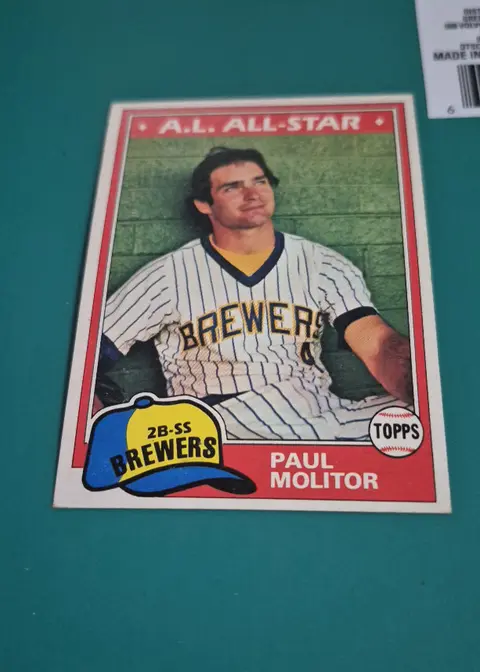
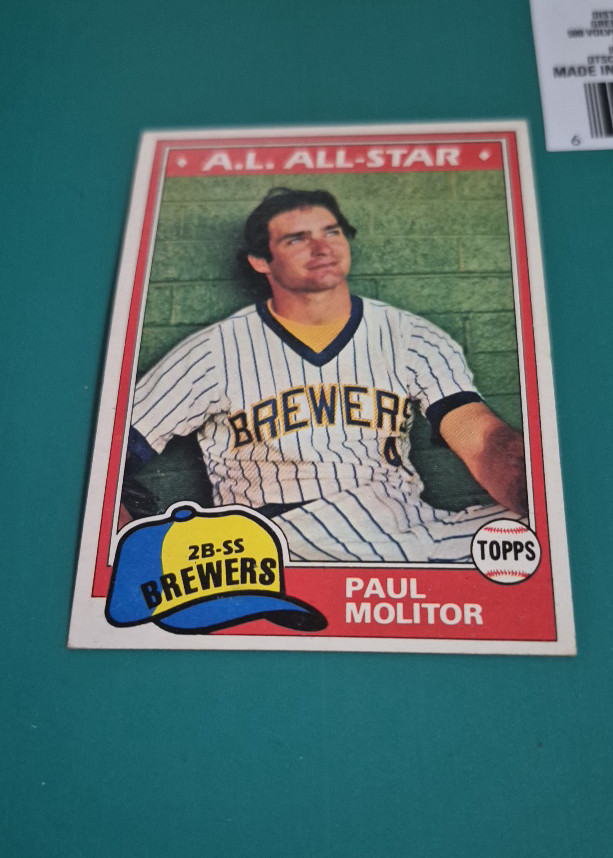
1981 Topps set release, featuring Molitor as an All-Star selection during his prime years with the Milwaukee Brewers
- Molitor finished his career with 3,319 hits, ranking him among baseball's all-time greats
- He holds the record for most hits in a single World Series game with five hits against the St. Louis Cardinals in Game 1
- Elected to the National Baseball Hall of Fame in 2004
- Led the league in runs and hits three times each during his career
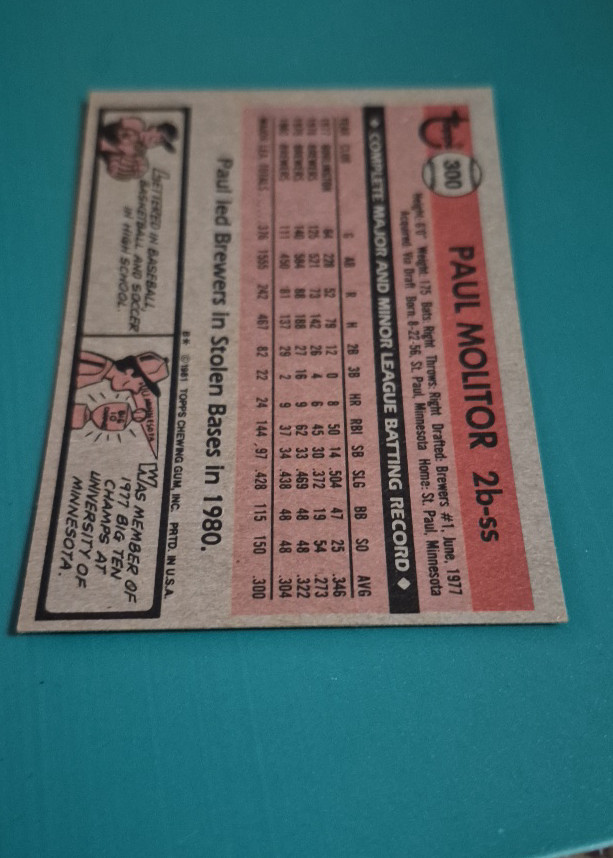
- Career statistics include 1,782 runs scored, 1,307 RBI, 234 home runs, 504 stolen bases, and a .306 batting average
Rarity and print run
- Tier
- Common
- Print run
- High
- First printed in
- 1981 Topps
- Demand
- Medium
- Supply
- Abundant
- Part of base set release with very high print run typical of 1981 Topps
- All-Star designation does not confer rarity in this set
- Over 45 years of survival means substantial quantities remain in circulation
- No special print variations or limited edition status
Collector notes
Condition. Common flaws to check include soft corners (noted in available listings), centering issues, and print spots typical of 1981 Topps production. The card's surface can show wear from handling over 45+ years.
Storage. Store in a cool, dry place away from direct sunlight. Use acid-free sleeves and storage boxes. For valuable graded copies, maintain in protective slabs. Avoid excessive handling of ungraded copies.
Authenticity. 1981 Topps cards are generally straightforward to authenticate due to established printing standards. Check for consistent dot-matrix printing patterns, proper card stock thickness, and accurate color registration. Reprints from later decades typically show noticeable quality differences in printing precision.
Sources: psacard.com, sportscardinvestor.com, sportscardspro.com, bonanza.com, steinersports.com