Market outlook
Stable Outlook 8/10
Long-term demand is anchored by nostalgia and competitive collector interest, but the card is already well-known and widely traded, so major near-term spikes depend on grade, provenance, and market sentiment.
Next months. Likely to remain firm with strong interest in clean graded copies and modest movement in raw played copies.
Long term. Expected to stay a blue-chip classic Yu-Gi-Oh! collectible, with best-in-class graded first-edition examples likely to outperform lower-grade raw cards.
History
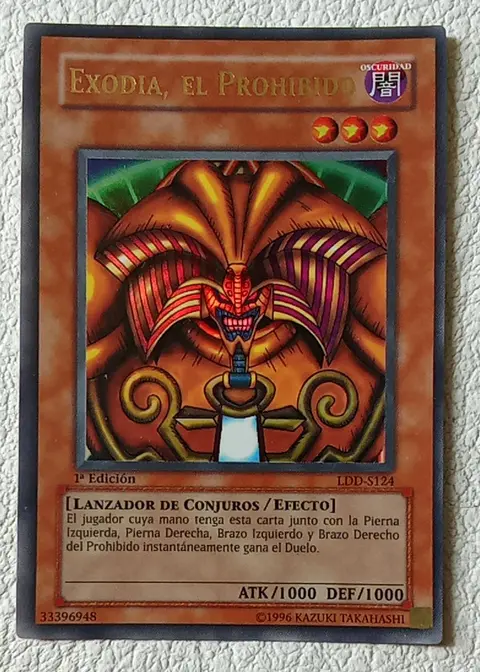
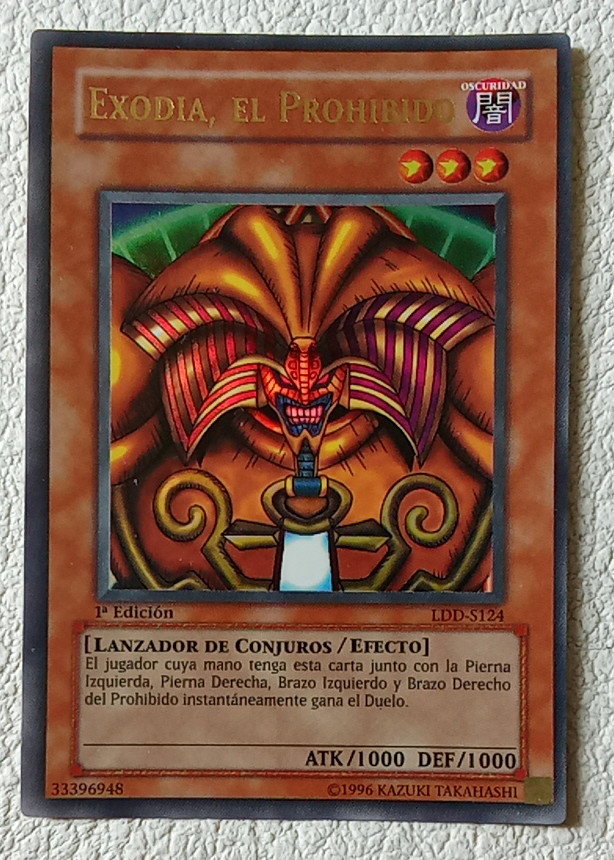
Exodia, the Forbidden One is one of the most iconic monsters in Yu-Gi-Oh!, introduced as the automatic win-condition “five-piece” forbidden monster whose head, arms, and legs together end the duel when assembled in hand. In Spanish releases it is known as Exodia, el Prohibido, and the character became a core symbol of early Yu-Gi-Oh! trading card game history and collector demand.
The card was first released in the Yu-Gi-Oh! OCG/TCG line in the early 2000s as part of Legend of Blue Eyes White Dragon, with the English first edition identified as LOB-124; Spanish collector-market listings also reference a Spanish first-edition Ultra Rare version marked S124 / LDD-S124.
- One of the most famous forbidden pieces in Yu-Gi-Oh!, originally tied to the story concept of an instant-win hand combo.
- Early Ultra Rare printings of Exodia are among the most chased cards from the classic era because condition-sensitive copies are difficult to find.
- Spanish-language collector listings commonly associate the card with first-edition Ultra Rare status and the #124 numbering, making it a highly collectible regional variant.
Rarity and print run
- Tier
- Ultra Rare
- Print run
- Very High
- First printed in
- Legend of Blue Eyes White Dragon
- Demand
- Very High
- Supply
- Low
- Iconic early Yu-Gi-Oh! chase card
- First-edition copies are especially desirable
- High-grade examples are difficult to find due to age and wear
- Spanish regional versions add language-specific collector interest
Collector notes
Condition. Check heavily for edge wear, corner whitening, surface scratching on the Ultra Rare foil, centering, and any bends or creases. Classic-era Exodia copies often show fraying on the back edges and foil scratching around the name box or artwork area.
Storage. Use a penny sleeve plus a rigid top loader or card saver, keep away from humidity and UV light, and avoid friction from binder rings. For high-grade copies, store in an acid-free sleeve inside a sealed semi-rigid holder.
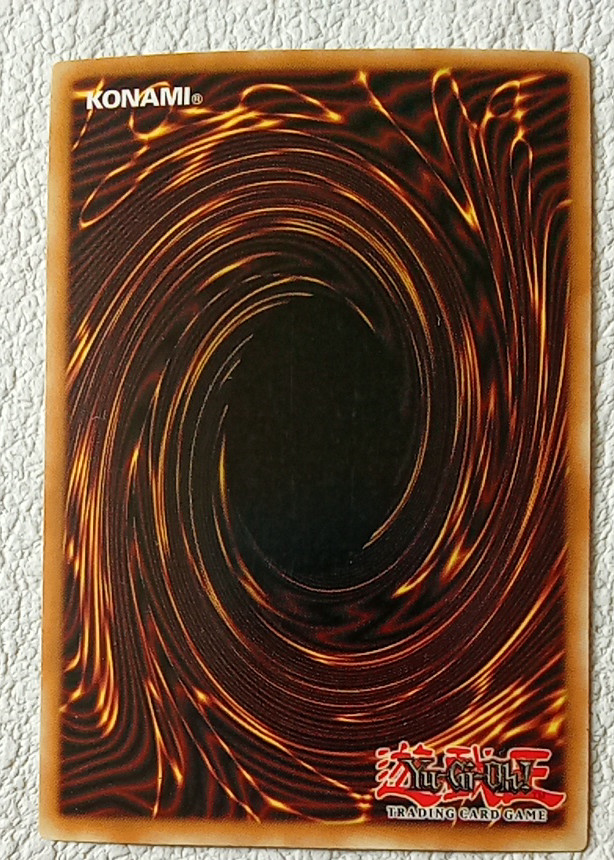
Authenticity. Verify correct card text, artwork, set numbering, language, and foil pattern consistency. Counterfeits often have poor text sharpness, incorrect font weight, wrong backside coloration, or foil that looks too flat or too sparkly. For Spanish first-edition copies, confirm the regional numbering and edition stamp are cleanly printed and aligned.
Sources: ebay.fr, wjplayingcard.com, cn.ebay.com, pricecharting.com, cardtrader.com