Market outlook
Rising Outlook 6/10
Recent 51.9% 30-day gain in raw NM pricing reflects growing vintage TCG demand; high-grade sales show steady appreciation[2][6]
Next months. Stable to modest gains in next 3-6 months with seasonal auction upticks
Long term. Moderate appreciation over 1-3 years for graded copies due to supply wear
History
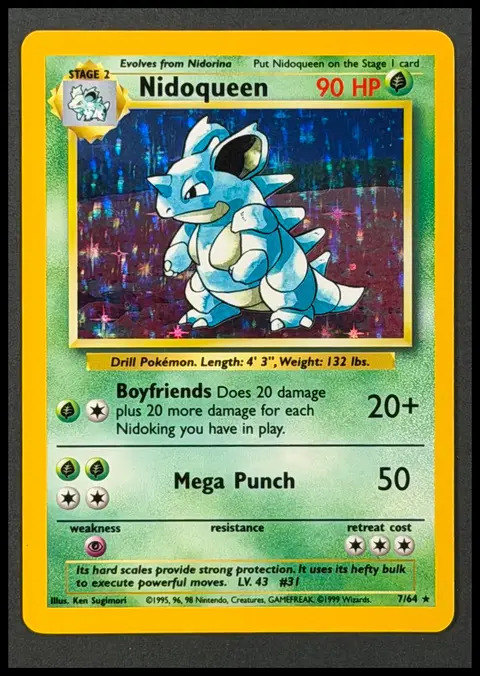
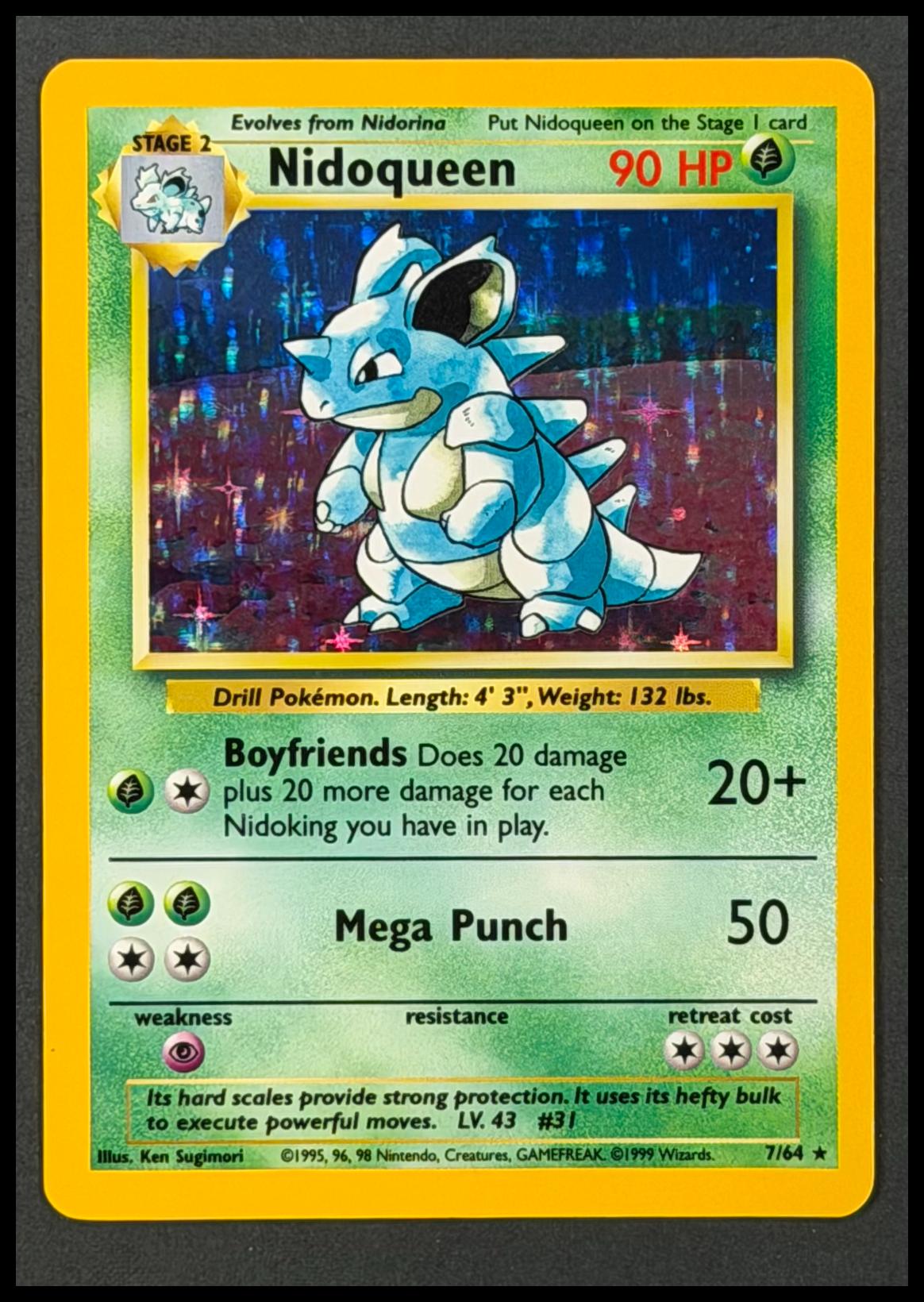
Nidoqueen is the fully evolved form of Nidoran♀ from the Pokémon franchise, debuting in Generation I. A Poison/Ground-type Pokémon, it is the female counterpart to Nidoking, known for its powerful physique, maternal protectiveness, and ability to use its barbs and tail in battle, originating from the Kanto region in the 1996 Pokémon Red and Green games.
First released in the Jungle expansion set in June 1999 by Wizards of the Coast in English for the Pokémon TCG in North America.
- Nidoqueen #7/64 is from the first Base Set expansion after the original Base Set, featuring classic holographic artwork by Ken Sugimori.
- The Jungle set introduced new Pokémon and mechanics, with Nidoqueen as a Stage 2 evolution card with 90 HP and attacks like Body Slam.
- 1999 Jungle cards are foundational WOTC-era printings, highly sought by vintage collectors.
Rarity and print run
- Tier
- Rare
- Print run
- High
- First printed in
- Jungle (1999)
- Demand
- Medium
- Supply
- High
- 1st Edition stamp increases scarcity over Unlimited
- Holo foil prone to condition degradation reducing gem mint supply
- High original print run but age-related attrition
Collector notes
Condition. Check for centering issues common in WOTC holos, holo scratching on the female symbol and artwork, edge whitening, surface print lines, and corner dings; print dots and roller marks are typical factory flaws.
Storage. Use semi-rigid holders or top-loaders with sleeves in cool, dry conditions away from sunlight to prevent holo foil oxidation; avoid stacking without sleeves.
Authenticity. Verify black star or Jungle symbol placement, font accuracy on text box, crisp holo pattern without blurring, and exact artwork shading; fakes often have off-color borders or incorrect rarity symbols; use graded or graded population reports for cross-reference.