Market outlook
Stable Outlook 5/10
Consistent pricing for Unlimited fourth print due to high supply; minor fluctuations from nostalgia but no major drivers like grading pops or pop culture events.
Next months. Stable $15-30 ungraded, graded high-end steady absent market shifts.
Long term. Stable to slight decline as supply persists; focus on early prints for growth.
History
Raichu is the evolved form of Pikachu, a famous Electric-type Pokémon from the Pokémon franchise created by Satoshi Tajiri and Ken Sugimori. Debuting in the original 151 Pokémon as #026, Raichu evolves from Pikachu via Thunder Stone and is known for its powerful electric attacks and increased size and power compared to its pre-evolution, playing a significant role in the anime, games, and trading card game as a staple Lightning-type card.
First released in the Pokémon Base Set in January 1999 in the United States by Wizards of the Coast as part of the English TCG launch.
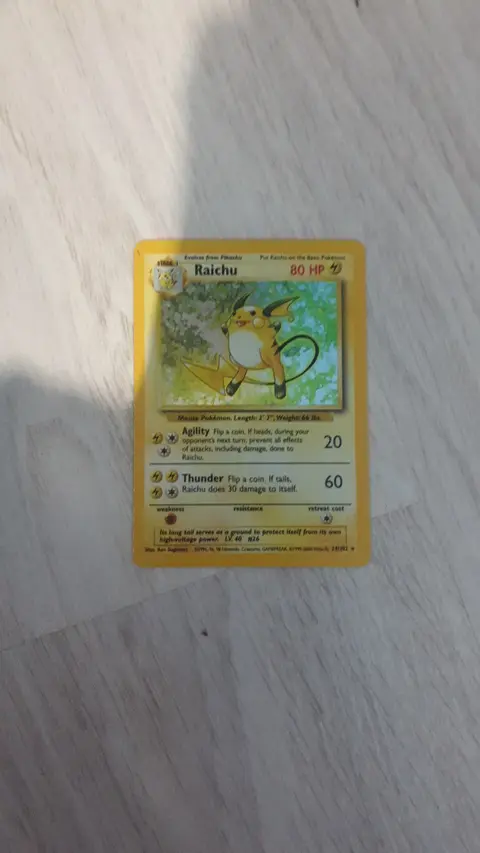
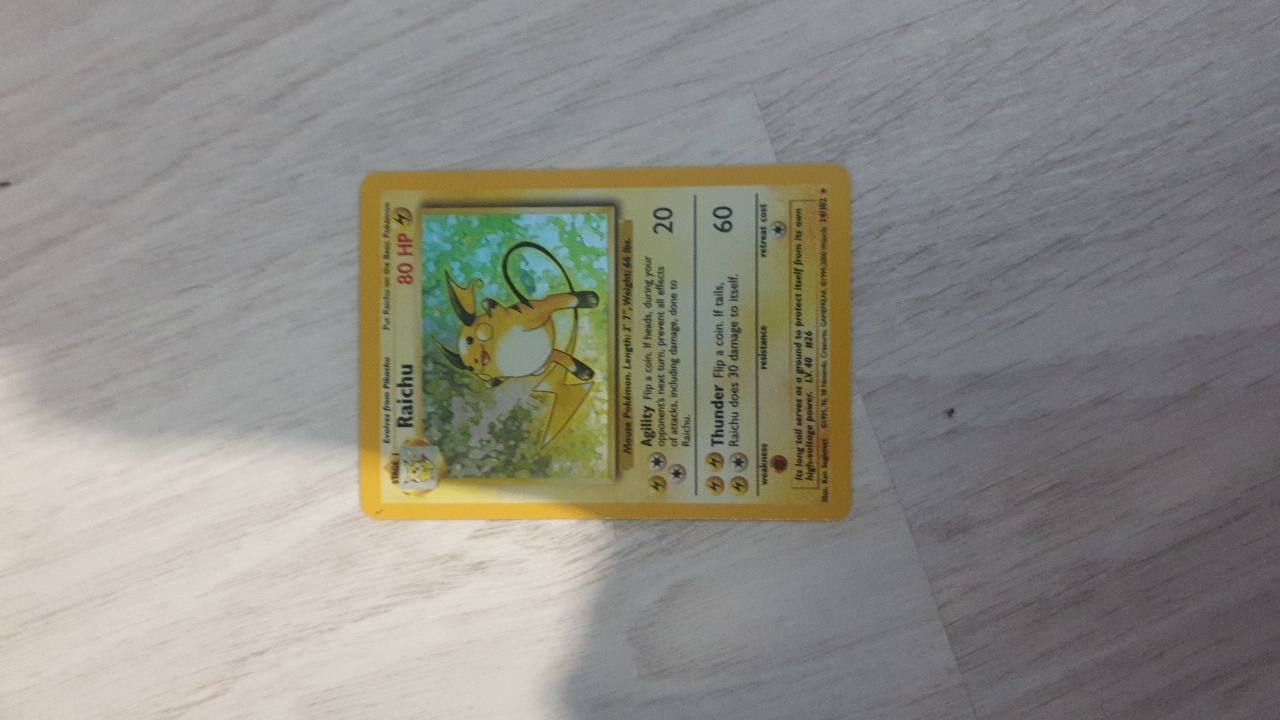
- Raichu #14/102 is a Stage 1 Lightning Pokémon with 80 HP, attacks including Agility (20 damage, coin flip for evasion) and Thunder (60 damage, self-damage on tails flip).[5]
- The 1999-2000 Fourth Print refers to the Unlimited edition's fourth printing run, marked by specific copyright dates and lacking shadowless features of earlier prints.[2]
- Base Set Raichu is iconic for its holofoil artwork by Mitsuhiro Arita, depicting Raichu unleashing electricity.
Rarity and print run
- Tier
- Rare
- Print run
- Very High
- First printed in
- Base Set (Unlimited Edition)
- Demand
- Medium
- Supply
- Abundant
- Fourth print Unlimited edition had massive print runs post-initial hype, reducing rarity compared to Shadowless or 1st Edition.
- Holofoil printing defects common, flooding low-grade market.
- No special stamps or errors in standard variants.
Collector notes
Condition. Check for centering on holo pattern (common off-center in Unlimited prints), edge wear from chipping, surface scratches on foil, and print lines or dots typical in fourth print runs; avoid cards with whitening on edges or bite marks.
Storage. Store in penny sleeves and semi-rigid top loaders, keep in cool, dry environment away from sunlight to prevent foil oxidation; use group storage boxes for ungraded cards and climate-controlled safes for high-value graded slabs.
Authenticity. Verify Wizards of the Coast copyright '1995, 96, 98, 99' on fourth print; check for thick black lines around artwork (absent in fakes), accurate holo grid pattern, and weight/thickness matching originals; use blacklight for ink fluorescence and consult graded/graded population reports.
Sources: pricecharting.com, pokecardvalues.co.uk, fanaticscollect.com, sportscardinvestor.com, tcgplayer.com