Market outlook
Stable Outlook 7/10
The card has enduring collector interest because Barry Bonds remains one of baseball's most recognized stars, but the card's very high supply keeps most prices anchored. Premiums for graded 10 and clean graded 9 examples should hold better than raw or lower-grade copies.
Next months. Likely stable to slightly firm for high-grade examples, with most movement driven by auction results and broader baseball card market sentiment.
Long term. Over 1-3 years, graded 9 and graded 10 examples should remain collectible and may appreciate gradually, while raw copies are likely to stay inexpensive and liquid.
History
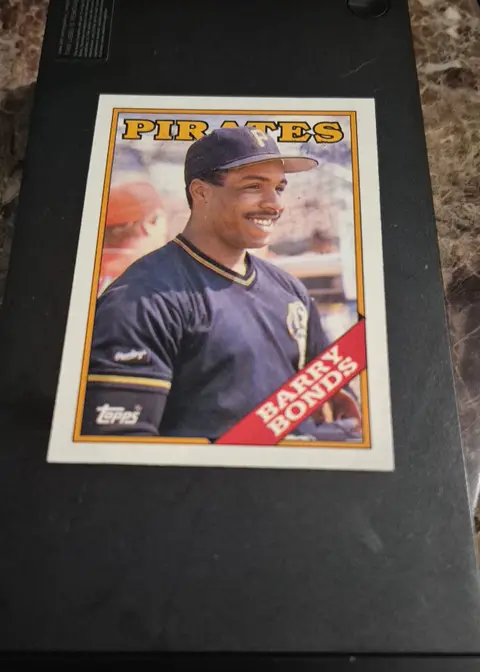
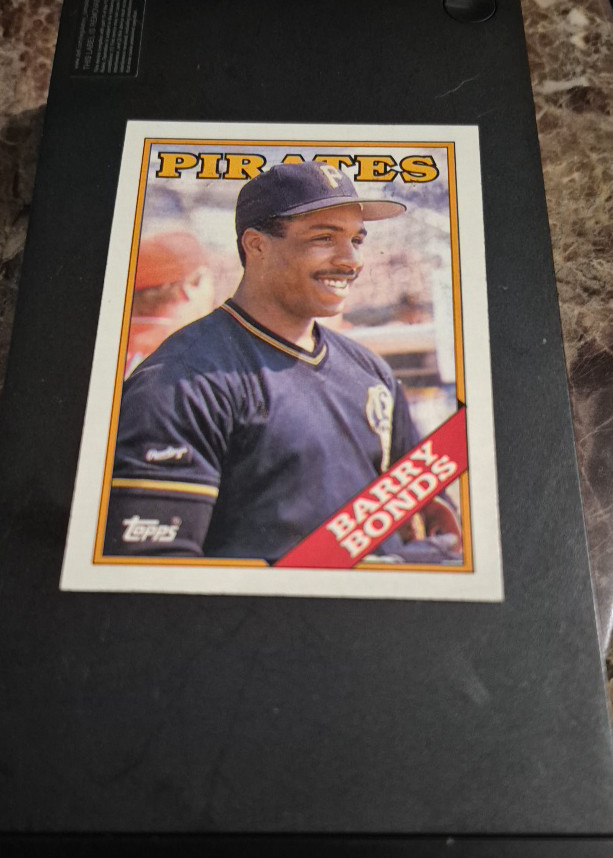
Barry Bonds is one of the most significant players in baseball history. Born in 1964, he is the son of former MLB outfielder Bobby Bonds and grew up around professional baseball. By the time the 1988 Topps card was issued, Bonds had already established himself as a rising star with the Pittsburgh Pirates after debuting in 1986. His combination of power, speed, and defensive ability made him one of the era's premier young talents and a future Hall-of-Fame-caliber player despite later controversy surrounding his career.
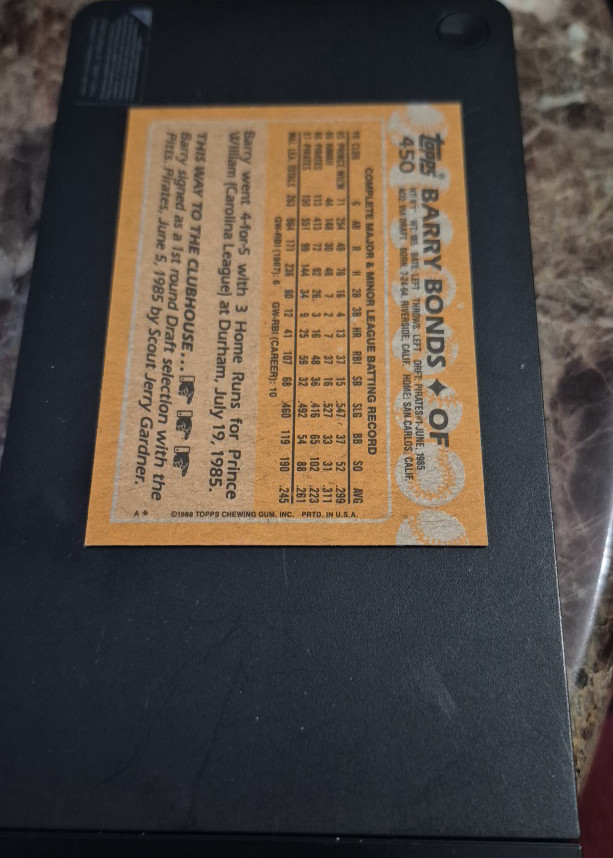
The card first appeared in the 1988 Topps Baseball set, released in 1988 in the United States through Topps' standard pack distribution to hobby shops, retail outlets, and wax/cello rack packs.
- This is one of Barry Bonds' key early career flagship Topps cards and is widely collected as a mainstream rookie-era issue from his second full MLB season.
- The 1988 Topps set is heavily mass-produced, so the card is common in raw form, but high-grade examples are meaningfully scarcer due to centering and corner sensitivity.
- The card is strongly associated with Bonds' breakout years and is one of the more desirable cards in the 1988 Topps set even though it is not his true rookie card.
Rarity and print run
- Tier
- Common
- Print run
- Very High
- First printed in
- 1988 Topps Baseball
- Demand
- High
- Supply
- Abundant
- Mass-produced flagship Topps base card with very high original print volume
- Raw copies are plentiful in the marketplace
- High-grade copies are harder to find because centering and corner wear limit graded 9/10 supply
- Collector demand is driven more by player significance than true scarcity
Collector notes
Condition. Check centering carefully, especially left-to-right and top-to-bottom. Common flaws include soft or white corners, edge wear from factory cutting, surface scratches, print defects, wax staining, and poor centering that keeps many copies out of top-grade slabs. The black-and-yellow design can make edge wear and corner whitening very noticeable.
Storage. Store in a penny sleeve and rigid top loader or card saver for individual protection, or in a clean archival box with sleeves for bulk storage. Keep away from humidity, direct sunlight, and temperature swings. Use acid-free, archival-safe materials to prevent staining and paper deterioration.
Authenticity. Authentic copies should match the standard 1988 Topps stock, gloss, and printing characteristics. Be cautious of oversized reprints, altered borders, and counterfeit slabs. Compare font sharpness, card stock thickness, and the reverse print quality against a verified authentic example. For high-grade or higher-value copies, third-party grading is strongly recommended.
Sources: oldsportscards.com, vaultedcollection.com, etsy.com, collectibles.com, psacard.com